


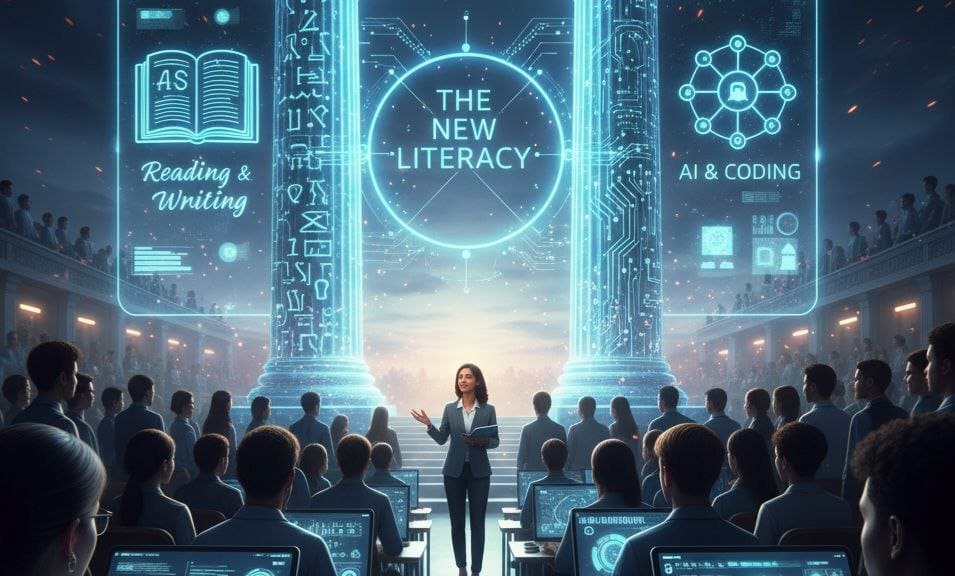
AI amplifies, rather than erases, human developmental skills.
The article argues that Artificial Intelligence should be viewed as a replacement for human cognition, but as an evolutionary extension of it – much like the development of reading and writing.
- Encoding and decoding: Literacy is defined as the ability to both consume and create using symbols. The article suggests AI is a “new literacy” because we are learning to translate intent into prompts and evaluate complex outputs, which constitutes a new form of encoding meaning.
- Evolutionary context: Literacy originally repurposed visual systems meant for tracking and face recognition; it transformed culture but did not eliminate talking or listening. AI is predicted to follow a similar path, adding a layer of skill rather than erasing what came before.
Every time a new technology arrives, we’re told it will replace what we already know. With Artificial Intelligence (AI), the anxiety is even sharper: Will it make our skills obsolete? Will it change how humans learn at the deepest level?
It will change us – however, not by erasing what came before. AI is better understood as a new literacy: another layer of skill that builds on, rather than replaces, the foundations of human development.
The foundation: ball mastery in soccer
Tom Byer, one of the world’s best-known youth soccer coaches, famously gave his 16-month-old son a ball to walk with. For Byer, the essence of soccer is not tactics or competition but ball manipulation: the small, sensorimotor connections between body and object that begin in early childhood.
Soccer, in this view, starts as soon as a toddler takes those first clumsy steps with a ball. Only later do strategy, passing, and team play emerge. Learning follows the same trajectory – it begins in the body, in perception and movement, and only gradually builds toward higher-order skills.
The extension: rackets and reading
Now think about tennis. You still need to run, track the ball, and position your body – the same foundation soccer demands. But add a racket, and the game transforms. The tool extends your reach, creates new possibilities, and changes your strategies. Yet none of this happens without the fundamentals.
Reading offers another example. Humans didn’t evolve eyes for reading; we evolved them to track motion, recognise faces, and navigate the environment. Millennia later, those visual systems were repurposed for literacy. Reading was revolutionary, but it never eliminated talking and listening. It added to them.
The next layer: AI as literacy
AI belongs in this same lineage. Just as the racket extends the body’s reach, AI extends our ability to generate, connect, and interpret information. But it can’t substitute for the foundations of perception, language, and meaning-making.
The comparison to literacy is especially apt. Literacy isn’t just passive reading – it’s encoding and decoding, the ability to both consume and create with symbols. With AI, we are learning a new kind of encoding: how to translate intent into prompts, how to evaluate outputs, how to iterate toward meaning. This is genuinely a literacy, not just tool use.
The risks of skipping the basics
A child who never learns to control the ball at their feet won’t become a great soccer player, no matter how expensive the equipment.
A student who never learns to listen and speak won’t truly master reading, no matter how many books they own.
And a learner who never practices core skills will not master AI, no matter how advanced the software.
At the societal level, the risk is even greater: If we lean too heavily on AI without grounding it in human learning, we may lose our bearings altogether.
What this means in practice
So what does “grounding in fundamentals” actually look like alongside AI?
In a fifth-grade classroom, it might mean students still draft essays by hand before refining them with AI feedback – maintaining the cognitive work of organising thoughts while gaining a more sophisticated editorial partner.
In coding education, it might mean beginners still debug simple programmes manually before using AI to tackle complex architecture.
The foundation comes first; the extension amplifies it.
From foundations to flourishing
AI is not a rupture but a cognitive extension. It is the next racket, the next literacy, the next layer of human skill.
The real challenge for education is not whether AI will change us – it will – but how we integrate it into the scaffolding of development we already understand. If we get that right, AI won’t hollow out our abilities. It will amplify them, just as literacy and sport have done before.
AI is here to stay. The question is whether we will teach it as a replacement or as the next chapter in the long story of human learning.

published on 2 October 2025 on Psychology Today by Sussex Publishers LLC